Congratulations, You Are Medically Unfit to Sit in the Passenger Seat of Any Moving Vehicle
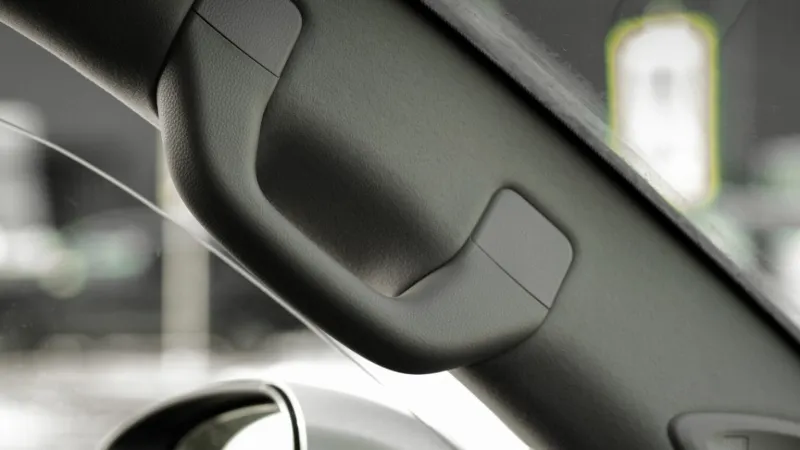
Photo: nervous passenger gripping car door handle anxious, via getcybertrucked.com
You passed your driving test. You parallel park on busy streets without breaking a sweat. You have merged onto the I-95 in rush hour traffic and lived to tell the tale. By every measurable standard, you are a competent, functioning adult who operates a two-ton vehicle with confidence and skill.
And then someone else starts the car.
Within four seconds, you are pressing an imaginary brake pedal into the floor mat, white-knuckling the door handle like it owes you money, and quietly calculating whether you could survive a tuck-and-roll exit at 38 miles per hour. You are not fine. You have never been fine. The passenger seat has revealed your true nature, and your true nature is absolutely unhinged.
Yep, that's a thing.
The Phantom Brake Reflex: A Medical Mystery
It starts before you've even left the neighborhood. The driver — your spouse, your friend, your perfectly licensed Uber driver with a 4.9 rating — approaches a stop sign at a completely reasonable speed. Your right foot disagrees. It shoots forward, stamps the floor mat with full conviction, and achieves absolutely nothing except making you look like a man attempting to stop a freight train with his shoe.
You do this every single time. You have done this for years. The floor mat beneath your feet is visibly worn down in one specific spot. A podiatrist has expressed concern. You have no explanation.
The phantom brake is not a conscious choice. It is a biological response, like blinking or flinching when someone throws something at your face. The difference is that blinking is normal and your phantom brake is causing your passenger-side relationships to deteriorate in real time.
Your Unsolicited Commentary Has Its Own Running Time
Here is what you tell yourself: you are simply staying alert. Being a good co-pilot. Helpful, even.
Here is what is actually happening: you have been providing a live audio commentary of someone else's perfectly legal driving for the past forty minutes and nobody asked you to do any of it.
"You might want to get over." The exit is in two miles. "There's a car back there." Yes, roads have cars on them. "Is this the speed limit?" It is. "I just feel like the lane to the left is moving faster." It is not. "Were you planning to brake?" They were already braking. You just couldn't tell because you were too busy narrating.
The driver has gone quiet. Not peaceful quiet. The specific quiet of a person choosing not to say the thing they are thinking. You interpret this as an invitation to continue providing feedback. You are wrong.
The Armrest Situation
At some point — usually around mile six — your hand found the overhead grab handle. You don't remember reaching for it. You don't remember deciding this was necessary. One moment it wasn't there, and the next moment you were gripping it like a roller coaster was imminent.
You are on a surface street. The speed limit is 25. There is a Walgreens on the left.
And yet: the handle. Both hands now, briefly. A small noise escaped you when the driver changed lanes. You called it clearing your throat. The driver called it something else entirely when they got home and told the story.
The Deeply Held Conviction That You Are The Only One Who Can Drive
Here is where we arrive at the real issue, and it is important that we address it directly: you believe, on some fundamental level, that you are the only person on earth who actually knows how to drive correctly.
Not maliciously. Not consciously. But somewhere in the operating system of your brain, there is a file labeled Correct Driving and it contains exactly one profile, and that profile is you. Everyone else — your partner, your friends, professional drivers with commercial licenses, people who have been driving for forty years without incident — is operating on a slightly flawed version of the system that only you can see the errors in.
This is why you gasp. This is why you tense up at yellow lights that are, by any objective measure, still yellow. This is why you have opinions about someone else's following distance when you are not the one driving, not the one responsible, and not the one who will ever be asked.
You are a backseat driver in the front seat. That's somehow worse.
A Modest Proposal
There is no cure for this. Research suggests the phantom brake reflex is hardwired into the human nervous system of anyone who drives regularly, and no amount of self-awareness has ever stopped anyone from doing it. You will gasp. You will grip. You will offer unsolicited lane-change recommendations until the end of time.
The best you can do is acknowledge it, warn your driver in advance, and perhaps invest in a stress ball to give your right foot something else to think about.
Or, alternatively, just drive everywhere yourself.
Which, let's be honest, is what you wanted all along.