Tap. Tap. Tap. Tap. Insert. Sorry. The Complete Emotional Collapse of a Failed Contactless Payment
It begins, as most tragedies do, with confidence.
You have your card ready. Or your phone. Or your watch, because you are a person who pays with their watch now, which felt futuristic when you set it up and now just feels like an additional way to fail in public. The line behind you is not long, but it is present. There are people. Witnesses. A teenager working the register who has seen things.
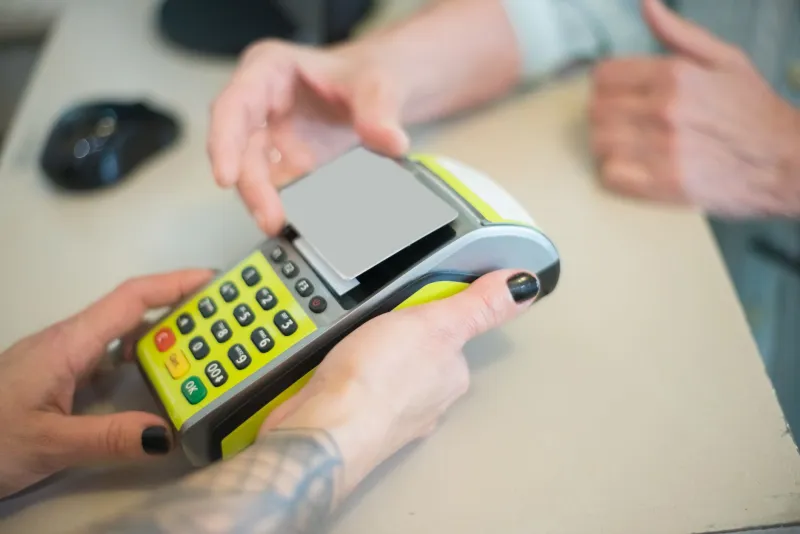
You tap your card against the terminal.
The terminal blinks red.
And this — this — is where the story really begins.
The First Tap: Pure Innocence
The initial failed tap is not yet a crisis. It is a blip. A minor technical hiccup that could happen to anyone and means absolutely nothing about you as a person or your relationship with modern technology.
You pull the card back. You look at it briefly, as though the problem might be visible to the naked eye. You look at the terminal. You look at the card again. You perform the universally understood gesture of someone who has not panicked yet: a small, knowing nod, as if to say ah yes, sometimes these things need a moment.
You tap again.
Red.
The Second Tap: The Performance Begins
This is the tap where the social machinery kicks in. You are now aware of the line. You are aware of the cashier. You are aware that this is taking longer than it should, and more importantly, you are aware that everyone else is also aware of this.
You deploy the laugh. Not a real laugh — a performative one. A "that's weird" chuckle that communicates ease and mild amusement and absolutely zero internal distress. The laugh says: I am a relaxed person who finds minor technology failures charming rather than existentially threatening.
You may also say the words "that's weird" out loud, just to make sure the laugh lands. You say them to nobody in particular. Maybe to the terminal. Maybe to the universe.
You tap a third time, but differently — with more intention, a slightly different angle, as though the problem is geometric rather than systemic. This is the tap of someone who has a theory. The theory is wrong.
Red.
The Third Tap: The Negotiation Phase
By tap three, you have entered a psychological space that has no clean name but that every American adult recognizes immediately. It is the space between "this is fine" and "this is a problem," where you are doing everything in your power to stay on the fine side of the line while the evidence accumulates against you.
You try holding the card against the terminal for longer. Maybe it needs more time. Maybe it's a duration issue, not a functionality issue. You press the card flat against the reader with the focused energy of someone performing a medical procedure.
The terminal considers this.
The terminal blinks red.
The teenager behind the register says nothing, but you can feel them preparing to say something, and that is somehow worse than them actually saying it.
The Fourth Tap: The Death of Dignity
This tap is different from the others. This tap is not about the payment anymore. This tap is about refusing to accept the reality that is being presented to you by a piece of equipment the size of a paperback novel.
You know, at this point, that the tap is not going to work. Some part of your brain has known this since tap two. But there is something in the human spirit — some deeply irrational, deeply American refusal to be defeated by a blinking red light — that demands one final attempt.
You tap. You already know.
Red.
The teenager says, gently, with the specific kindness reserved for elderly relatives and people in the middle of a public breakdown: "You can try inserting it?"
The Insert: A Spiritual Surrender
You insert the card.
You do not make eye contact with anyone.
The terminal processes the payment immediately — instantly, cheerfully, without any of the drama of the previous ninety seconds — as though it has been waiting this whole time for you to simply do the obvious thing and is relieved you've finally arrived at the correct answer.
The receipt prints. The transaction is complete. You gather your items with the careful, deliberate movements of someone who is fine, who was always fine, who found this whole situation mildly amusing and not at all a referendum on their competence as a functioning adult in the twenty-first century.
The Broader Chaos of American Payment Technology
Here is the thing that nobody wants to say out loud but that every person in this country privately knows: American payment technology is a lawless frontier, and nobody has any idea what's going to work anywhere.
Some gas stations require a PIN for contactless. Some cafes only accept Venmo. Some restaurants have the chip reader but the chip reader hasn't worked since 2019 and the staff will tell you this only after you've attempted it twice. Some grocery stores have tap-to-pay enabled on four of their six terminals, and there is no signage indicating which four, and the only way to find out is to be the person who finds out.
You have, at various points in the last calendar year: been told a place is cash only after ordering; discovered mid-transaction that a terminal requires a minimum purchase for card use that is one dollar more than what you're buying; watched a payment go through on your phone only to be told by the cashier that it didn't go through on their end; and paid with Apple Pay at a terminal that then asked you to sign, which — what?
The system is not a system. It is a collection of individual, uncoordinated payment experiences loosely connected by the shared hope that something in your wallet will eventually work.
And yet every time, every single time, you approach the terminal with the quiet confidence of someone who has done this a thousand times.
You tap.
Red.
Here we go.