The Haircut Hostage Situation: A Psychological Study in Smiling Through Your Own Follicular Destruction
The Moment Everything Goes Wrong
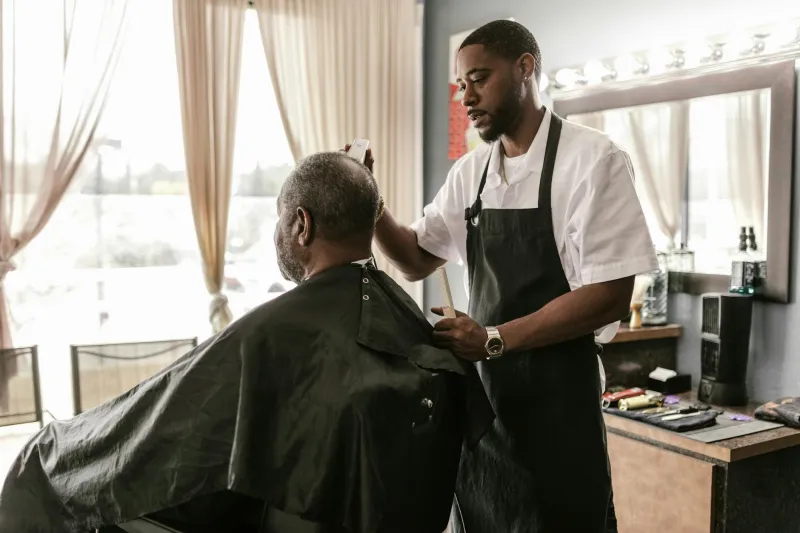
There's a precise moment in every bad haircut when your brain processes what's happening, but your mouth continues to operate on autopilot, nodding enthusiastically while your reflection shows clear evidence of follicular crimes against humanity. Scientists have now identified this phenomenon as "Follicular Stockholm Syndrome" – the psychological condition where victims become emotionally attached to their captor, even when that captor is actively destroying their ability to show their face in public for the next six weeks.
Dr. Amanda Foster, who leads the Institute for Regrettable Life Choices, explains: "The barber chair represents the only consumer transaction in America where people completely abandon their right to quality control. We've documented cases where customers have tipped 25% for haircuts that violate the Geneva Convention."
 Photo: Geneva Convention, via assets.rebelmouse.io
 Photo: Institute for Regrettable Life Choices, via cdn.printerval.com
 Photo: Dr. Amanda Foster, via osumedicine.com
The Anatomy of Denial
The progression of a haircut disaster follows a predictable psychological pattern that researchers have mapped with scientific precision:
Stage 1: Optimistic Delegation (Minutes 0-3) You settle into the chair with complete confidence in human competency. You've shown a photo. You've explained your vision. You believe in the fundamental goodness of trained professionals.
Stage 2: The First Red Flag (Minutes 4-7) Something feels wrong. The first cut seems... aggressive. But surely this is part of the process. Professional stylists know things you don't. This is probably a technique.
Stage 3: Silent Panic (Minutes 8-12) Your brain begins processing the mathematical reality that hair doesn't grow back immediately, while your mouth continues making encouraging sounds. You're now actively participating in your own follicular destruction.
Stage 4: Aggressive Positivity (Minutes 13-20) You become the haircut's biggest cheerleader, offering enthusiastic commentary like "Oh wow, that's really different!" and "I never would have thought of that!" Your survival instinct has kicked in, and apparently, it's decided that excessive enthusiasm is the best defense mechanism.
Stage 5: Delusional Acceptance (Minutes 21-25) You've convinced yourself this is actually avant-garde. Maybe asymmetrical bangs are having a moment. Perhaps this is how fashion-forward people look. You begin planning how to explain this as an intentional choice.
The Psychology of Captive Gratitude
What makes this phenomenon particularly fascinating is the genuine gratitude victims express toward their stylistic captors. Even while staring at clear evidence of follicular malpractice, customers find themselves saying things like "It's so much more manageable now!" and "You really transformed my whole look!"
Dr. Foster notes: "We've identified what we call 'aggressive thankfulness' – the psychological defense mechanism where people become increasingly grateful as the situation becomes increasingly dire. It's like emotional overcompensation for the reality they're refusing to acknowledge."
The Tip Paradox
Perhaps the most puzzling aspect of Follicular Stockholm Syndrome is the tip calculation that follows. Logic would suggest that payment should correlate with satisfaction, yet research shows an inverse relationship: the worse the haircut, the more generous the tip.
This occurs because the psychological trauma of acknowledging the disaster is so overwhelming that customers instead choose to reinforce the fiction that everything went exactly as planned. Tipping well becomes proof that you're the kind of person who makes intentional, sophisticated choices about asymmetrical hair situations.
"We've documented cases where people have tipped 30% for haircuts that required emergency hat purchases," explains Dr. Foster. "The tip becomes a payment for maintaining the shared delusion that this was the desired outcome."
The Great Pretense Protocol
Once the haircut is complete, victims enter what researchers call "The Great Pretense Protocol" – an elaborate performance designed to convince everyone (including themselves) that this was always the plan. This involves:
- Posting confident social media photos from strategic angles
- Claiming the style is "edgy" and "exactly what I wanted"
- Researching celebrities who might have worn similar styles
- Developing elaborate explanations for why this look is actually very sophisticated
- Avoiding mirrors for 3-6 weeks while planning the recovery strategy
The Mirror Avoidance Phase
The weeks following a haircut disaster are marked by what psychologists term "selective reflection engagement." Victims develop an almost supernatural ability to navigate daily life while avoiding direct eye contact with their own reflection.
Bathroom mirrors are approached from strategic angles. Car rearview mirrors are adjusted to show only forehead. Store windows become potential ambush sites requiring careful navigation. Some people report developing an entirely new route to work that avoids reflective surfaces.
The Social Complicity Network
What makes Follicular Stockholm Syndrome a truly social phenomenon is how friends and family become unwilling participants in the denial. When someone shows up with an obviously tragic haircut, society has developed an elaborate protocol of supportive lies:
- "It's so... you!"
- "I love how bold you're being with your style!"
- "It's going to look amazing once it grows out a little!"
- "You can totally pull that off!"
- "I've been thinking about doing something dramatic with my hair too!"
This creates a network of collaborative fiction that enables the victim to maintain their delusion while everyone politely agrees to participate in the charade.
The Recovery and Rationalization Process
The healing process from Follicular Stockholm Syndrome involves several distinct phases:
Week 1-2: Aggressive Styling Attempting to force the haircut into submission through the strategic application of products, accessories, and sheer willpower.
Week 3-4: Acceptance and Hat Shopping Coming to terms with reality while investing heavily in headwear and researching hair growth vitamins.
Week 5-8: The Waiting Game Developing an intimate relationship with hair growth timelines and discovering that "6-8 weeks" is actually a very long time.
Week 9+: Cautious Re-emergence Slowly returning to normal social activities while swearing to never again trust anyone with scissors.
The Evolutionary Purpose
Some researchers theorize that Follicular Stockholm Syndrome serves an important evolutionary function. Dr. Foster suggests: "In a world where we're constantly making decisions with incomplete information, the ability to convince ourselves that our choices were actually brilliant might be a crucial survival skill. The haircut disaster is just practice for larger life disappointments."
The Industry Response
Interestingly, many professional stylists have become aware of this phenomenon and actively work to break the cycle. The best ones will stop mid-cut and ask directly: "Are you actually happy with this direction, or are you just being polite?" This gives customers permission to express their actual preferences instead of maintaining the performance of satisfaction.
However, not all stylists have embraced this approach, leading to what researchers call "The Politeness Trap" – a situation where both customer and stylist know something is going wrong, but both continue pretending everything is fine.
The Beautiful Absurdity
In the end, Follicular Stockholm Syndrome represents something uniquely human: our incredible capacity to maintain optimism in the face of mounting evidence that we should probably panic. It's the same psychological flexibility that allows us to believe we'll start eating healthy on Monday or that we'll definitely organize our lives this weekend.
As Dr. Foster concludes: "The haircut disaster teaches us something profound about human nature. When faced with irreversible consequences, we don't just adapt – we convince ourselves we wanted this outcome all along. It's either a remarkable example of psychological resilience or proof that humans are capable of truly impressive self-deception. Possibly both."
So the next time you find yourself nodding enthusiastically while watching your hair dreams die in real-time, remember: you're not just getting a bad haircut. You're participating in one of humanity's most fascinating psychological experiments. And hey, at least you'll tip well.